Hold in Common


Some things were never meant to be owned.

Across eight centuries, the same quiet move repeats: things held in common, land, water, energy, food, seed, medicine, and knowledge itself, get fenced into private property, almost always through paperwork rather than force. Hold in Common tracks that enclosure as it happens, names the pattern, and follows the older work of keeping what belongs to everyone open to everyone.

The pattern

The Enclosure Algorithm

Enclosure is not weather. It does not fall from the sky. It is a repeatable procedure, an algorithm, that turns a shared resource into private rent, the same way every time. Once you can name the steps, you can see the program running anywhere, at any scale, in any century.

  1. TARGETFind shared value not yet owned.
  2. REFRAMECall the commons a tragedy, so seizure sounds like rescue.
  3. ABSTRACTTurn the living thing into a countable, ownable unit.
  4. TITLEVest the unit in a private owner, by paperwork.
  5. INVERTMake the old custom a crime.
  6. TOLLCharge for access, and dump the cost downstream.
  7. NATURALIZEErase the memory of the commons, so the fence looks like it was always there.
Then the rent funds the next capture, and it repeats.

An algorithm can be interrupted, and this one has a known inverse. The commons has been defended and rebuilt before, deliberately, step for step against the first. The whole of Hold in Common is the work of running it in reverse.
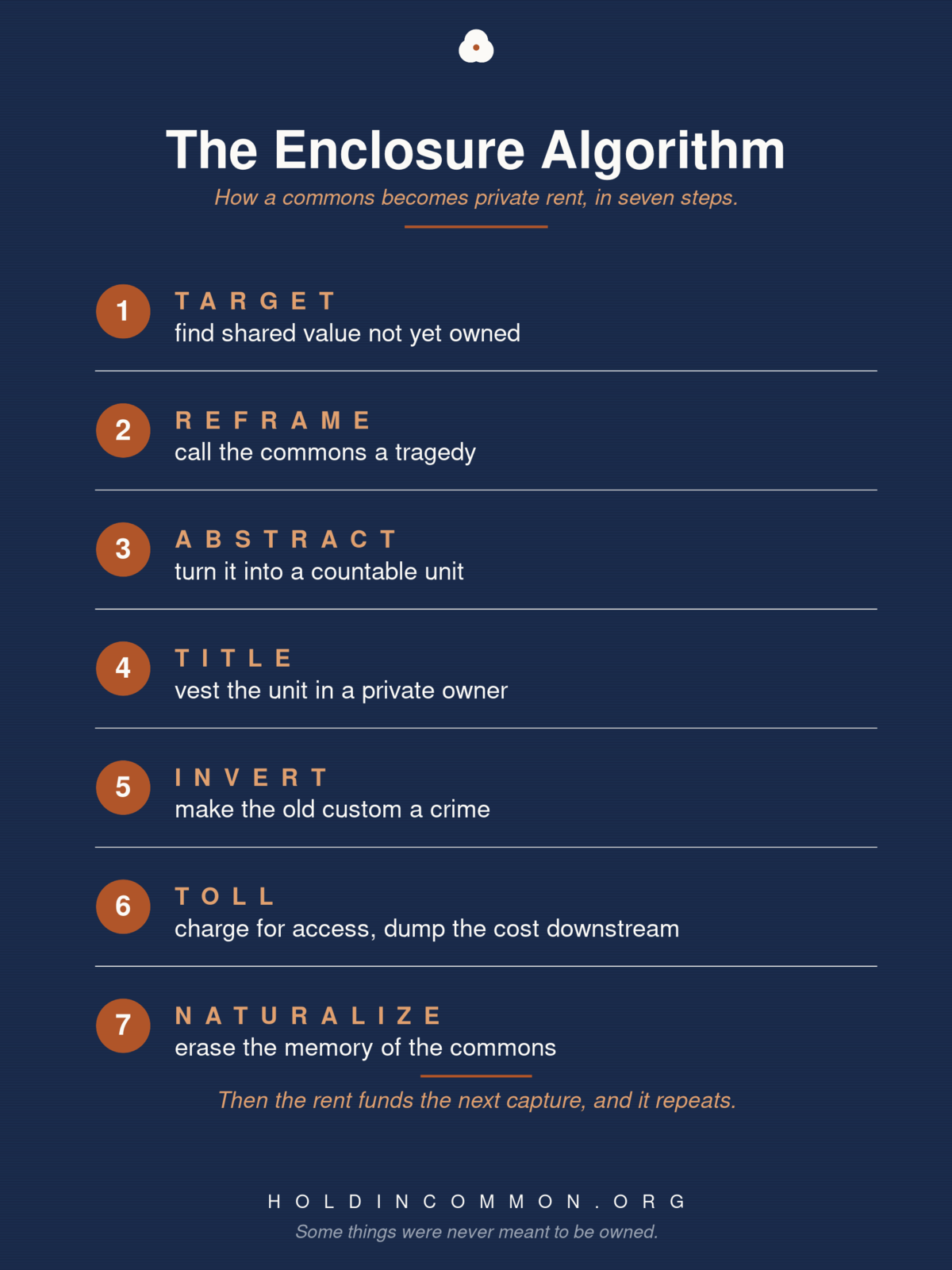
The Enclosure Algorithm, seven steps
The writing

Start here

The two essays are the keystone. The Quiet Fence tells the history; The Enclosure Algorithm gives you the reusable lens. Then Spot the Fence runs that lens on one commons at a time.

The Quiet Fence
Eight centuries of enclosure, from the English open fields to the genome, the seed, and the plant, and the older counter-tradition that keeps rebuilding the commons.
Essay · Read (PDF)
The Enclosure Algorithm
The pattern written out as a procedure you can run your finger down, with the energy commons worked through end to end, and the counter-algorithm.
Essay · Read (PDF)
Spot the Fence No. 1: The Cattle Market
Running the seven steps on the beef in your kitchen. Four companies, eighty-five percent of the market, and a rancher's share at a record low.
Series · Read (PDF)
Spot the Fence No. 2: The Sun on Your Roof
Running the seven steps on electricity. Free sunlight, a monopoly at the meter, and the cooperative grid we have already built before.
Series · Read (PDF)
Spot the Fence No. 3: The Water Underfoot
Running the seven steps on water. A public birthright, a cheap pumping permit, and water sold back by the bottle at thousands of times the cost.
Series · Read (PDF)
Spot the Fence No. 4: The Feed Bill
Running the seven steps on what animals eat. Four traders, the contract-growing trap, and how the same hand can sell the feed and buy the cattle.
Series · Read (PDF)
Free tool

The Field Guide to Spotting Enclosure

Seven steps, seven questions. A short, free pocket guide for seeing the fence go up while the gate is still open. Walk the questions on anything in your life that has quietly gotten more expensive or more restricted.

Download the Field Guide
Free. Pay what you want if it helps. Share it widely.
Guide · Download (PDF)
What is coming

The map

Every topic is a spoke that runs the algorithm on one commons and links back to the keystone. The library grows in clusters.

The Living Commons. Land, water, energy.
The Food & Farming Commons. The cattle market and meatpacking, seeds, plants and medicinal botany, animal feed.
The Body & Mind Commons. Medicine, access to education, knowledge and the public domain.
The Digital Commons. AI training data and attention, spectrum and the airwaves.
Support the work

Keep it in common

Hold in Common is independent and freely readable, and it is meant to stay that way. Your support funds the research and writing, keeps it answerable to readers rather than owners, and helps seed a nonprofit dedicated to keeping the public domain public. Some things were never meant to be owned, and that includes this work.

Become a supporting reader Make a one-time gift